Has anyone else used Claude Code or Codex and wondered how one small coding task turned into a never-ending project?
You ask for a change. It suggests another improvement, adds something else, then starts fixing problems outside the original brief. Unless you keep bringing it back to scope, the job keeps growing.
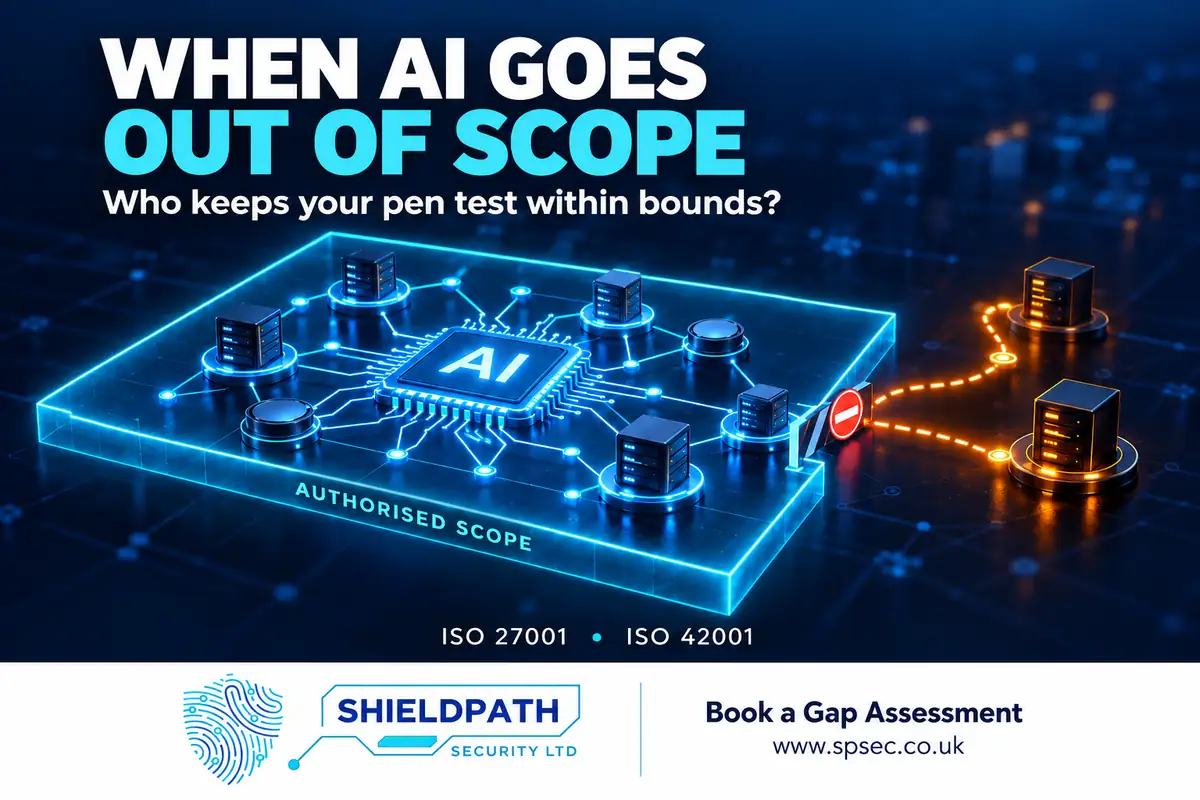
Now put that behaviour into AI-powered penetration testing.
What happens when an agent discovers another system and decides to investigate? Or attempts a more intrusive test because it wants to confirm a finding?
Finding something worth testing does not give you permission to test it.
As security practitioners, we need to think beyond what these tools can do and establish what they are authorised to do.
For me, that means:
- Technically enforcing approved targets and exclusions.
- Requiring human approval before intrusive actions or scope changes.
- Limiting credentials, access and execution time.
- Keeping records of actions and approvals.
- Having clear stop conditions and someone accountable for using them.
This is where ISO 27001 and ISO 42001 work together.
ISO 27001 provides the foundation for managing information security risks and protecting information. ISO 42001 addresses how organisations govern AI, including responsibilities, AI-specific risks, impacts and oversight throughout its lifecycle.
The overlap is practical: risk management, accountability, documented processes and continual improvement. Organisations can bring these together while still assessing the additional risks introduced by AI.
For an AI testing agent, that means connecting the security rules of the engagement with governance over how the agent operates, who approves its actions and how its behaviour is monitored.
The EU AI Act also reinforces the relevance of human oversight, particularly for systems classified as high-risk, where applicable.
A scope document is a starting point. The real test is whether your controls can keep an autonomous tool within it.
Can your organisation demonstrate where its AI’s authority ends?
Contact ShieldPath Security for an ISO 27001 and ISO 42001 Gap Assessment to understand where your security and AI governance controls need strengthening.
This article was first shared on LinkedIn. Join the conversation on LinkedIn.